Access Control in Alameda
Quoted once the doors are counted. Readers, keypads, electric strikes and credentials for suites, offices and yard buildings, with a key-operated way in left working on every leaf for the morning the power is out.
custom quote
Typical price
18 min
Avg. arrival
24/7
Availability
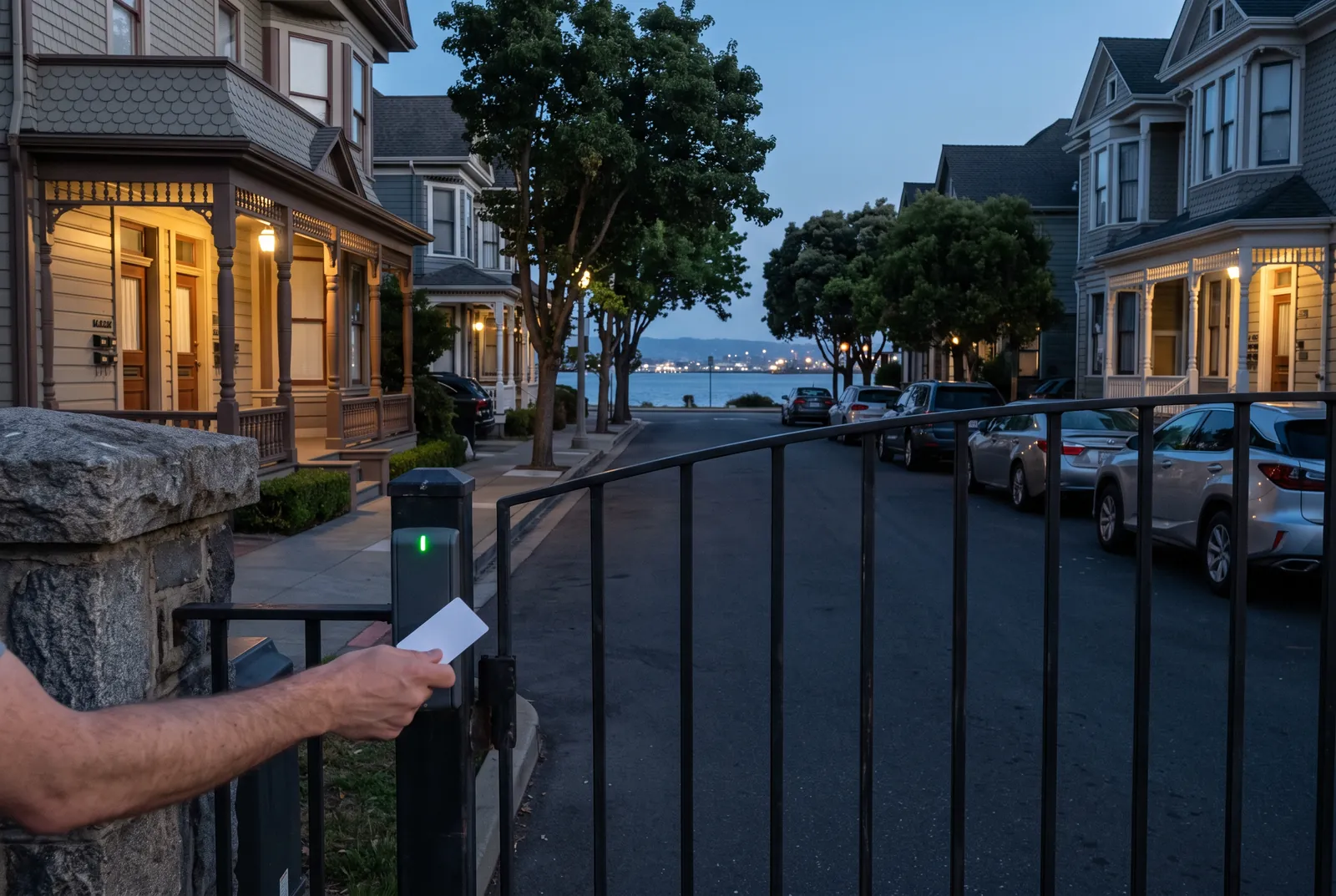
Once a key is out of your hands you cannot get it back. A credential you can switch off from a laptop on a Sunday night. That gap is the whole reason this page exists, and it is much more an argument about administration than about security.
The door where the difference is worth most on this island is the shared entrance. One cylinder, keys in the hands of every household, no reliable record of how many exist, and a fresh one cut somewhere every time a household changes. Put a reader or a keypad on that door and each household gets a credential of its own, a move-out takes half a minute, and nobody has to canvass the building for blades that may or may not come back.
What is covered here is the door end of a system: credentials and the controller that holds them, card and fob readers, keypads, exit sensors, and the electric strikes or magnetic locks that actually let go. Besides shared entrances it suits offices above the Park Street shops, a clinic with a records room that wants a log, a rear corridor shared behind a row of storefronts, and the working premises out at Alameda Point where several tenants come in through one yard or one gate.
This is a project for the owner or the management company rather than a resident, for the same reason as everything else on a shared door: it changes how everybody in the building gets in. Residents get enrolled and get shown how it works. The survey, the quote and the approval sit with whoever holds the property.
Every opening gets looked at for three things, and the answers pick the hardware rather than a catalog doing it. What the door is made of. What is hanging in it already. And how far it stands from power and from a network point. Wood or hollow metal with a deep frame takes a strike. Glass in a stile with no room for one takes a magnetic lock across the head, released by a sensor overhead and a push-to-exit button on the wall. An old entrance on a wooden house gets its own line in the quote, because the jamb may want building out before a strike has solid material to sit against. A yard gate is wired to the operator already fitted rather than being handed a new one. Controllers are specified with room left over, since buildings acquire doors. And most people would rather carry a phone credential than a card, which is worth knowing before anything is ordered.
Every building we finish still has one door with a metal cylinder in it, on a restricted key. That is deliberate design and not hedging. Strip the mechanical keys out of a building entirely and one power cut closes it, and on a shared entrance that means several households standing outside at the same time.
The trade line is the same one running through this whole site. Credentials, controllers, readers, exit sensors, strikes and maglocks belong to us. Fire panels, burglar alarms and gate motors do not. Quoting is per project and broken out line by line so that nothing disappears into a lump. The survey costs $89 and that comes off the job. Approve the quote and it holds; if an opening turns out to want preparation nobody anticipated, it is explained and agreed as its own line before the work happens rather than showing up at the end.
Sixteen jobs, fourteen of them with a range and two quoted once the openings have been counted on site. What moves a figure inside its range here is how many households the door serves: one cylinder and one key is the low end, while a street door that every flat carries a key to means a key plan rather than a lock, and that takes the high one. Say which door it is and who the building answers to, and the range closes to a single number on the call.
- Daytime (7am–8pm)standard rates
- Evening (8pm–12am)+$50
- Overnight (12am–7am)+$88
FAQ
Access Control: quick answers
Every move-out means cutting entrance keys again. Does a reader end that?+
For that particular problem, yes. A credential is switched off in under a minute, whereas a metal key that never came back means repinning a cylinder every household depends on. In a building with regular turnover the arithmetic favors a reader on the entrance and keys on the doors behind it. Putting a reader on every door in the place is rarely worth what it costs.
Does this mean no metal keys anywhere in the building?+
No, and you should not want that. At least one door keeps a mechanical cylinder on a restricted key. Electronics fail and power goes out, and a shared entrance with no metal route in leaves the whole building outside at once instead of one household.
There is nothing but glass and a narrow aluminum edge on our shop door. What can even be fitted?+
A magnetic lock across the head of the frame, since that stile has no room for a strike. On the way out a sensor overhead and a button on the wall release it. The Adams Rite deadlatch already in the stile is left exactly as it is, so once the maglock is off the door still locks with a key overnight.
Related
More commercial services
Open 24 hours, 7 days
Say whether it is the street door or your own, and the rest of the call is short
Alameda and Bay Farm, at any hour. Which leaf it is decides who approves the work, the door itself decides the work, and the work decides the number, which is settled on the phone with the $89 visit and any late hour already inside it. It reads the same on the receipt. Ninety days on the labor, in writing.