Master Key Systems in Alameda
Quoted once every opening has been walked and listed. A building of flats where the street door, the basement and the laundry have to be reachable by one key while each flat stays private, or a row of units with offices over the top.
custom quote
Typical price
18 min
Avg. arrival
24/7
Availability
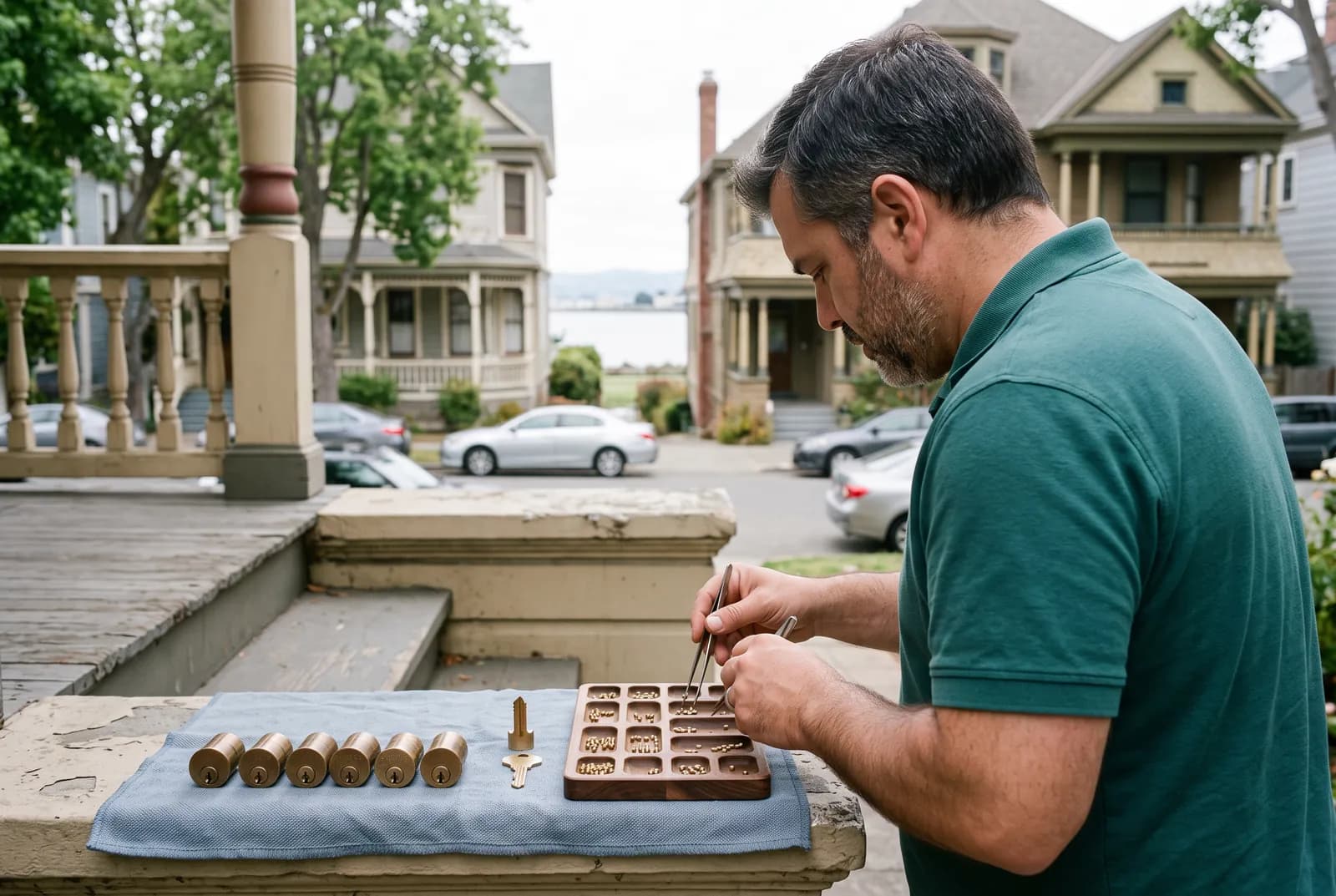
A master key system sorts a building into levels and expresses those levels in brass. Hold a change key and you reach one door. Hold a master and you reach the doors that serve everybody. Occasionally there is a tier above that for whoever owns or runs the property. Done with care it turns an unlabeled drawer of keys into a single key worth protecting. Done carelessly it puts somebody through a door they were never meant to reach, and that is a worse place to be than having no system.
The shape that recurs here is not an office tower. It is a wooden house divided into flats: an entrance, a stair, a row of mail boxes, a yard gate, a basement or a laundry, and four or five flat doors behind all of it. As things usually stand, the entrance and the gate each carry one cylinder with keys spread across every household, each flat door has its own unrelated key, and nobody holds an accurate list of either. A schedule fixes that. Residents carry a change key that opens the entrance, their own flat and their own mail box. The owner or the manager holds one master over the shared doors. When a household changes, one cylinder is repinned and the rest of the building carries on unaffected.
Nothing on this page gets priced over the phone. The building is walked opening by opening first: what is hanging in each one, whether those cylinders will take the pinning, who needs to reach where, and which doors are to be excluded outright. There is always at least one exclusion, and usually more than the owner expected. A basement with the meters and shut-offs in it. A storage room. A gate a neighboring property also uses.
Who commissions this is worth stating. A schedule crosses shared doors by definition, so it is ordered by the owner or the management company rather than by a resident. What residents get out of it is one blade instead of three, and a genuine list of who holds what.
Drawing it up is the real work; the pinning is an afternoon. Levels are sketched and agreed while every cylinder is still hanging where it belongs. Underneath everything sits a restricted keyway, which is what puts copying beyond the reach of a kiosk counter. Then master pins go in over change pins, cylinder by cylinder, and nothing is called finished until it has been tried in its own opening with both keys. Cylinders already on the building that are still sound get folded into the schedule rather than thrown out, and that is where most of the money is saved. Keys are stamped, numbered into a log, and signed for when they change hands. What you keep is a chart: doors down one side, keys along the top, empty rows waiting for whatever gets added.
Pricing arrives as one itemized figure once the walk is done. Too many variables move it for a printed range to mean anything: how many openings, how many levels, which keyway, and what condition each cylinder is in. The survey is the $89 trip and it comes off the job. Approve the figure and it holds. Later on, when a household changes, a single cylinder repinned into the existing schedule is $30 to $47.
Sixteen jobs, fourteen of them with a range and two quoted once the openings have been counted on site. What moves a figure inside its range here is how many households the door serves: one cylinder and one key is the low end, while a street door that every flat carries a key to means a key plan rather than a lock, and that takes the high one. Say which door it is and who the building answers to, and the range closes to a single number on the call.
- Daytime (7am–8pm)standard rates
- Evening (8pm–12am)+$50
- Overnight (12am–7am)+$88
FAQ
Master Key Systems: quick answers
We own a house here divided into four flats. Is that big enough to bother?+
It is exactly the size this suits. Each household carries one blade that opens the entrance, their own flat and their own mail box, and you hold a master over the shared doors. When one flat changes hands, that cylinder alone is repinned at $30 to $47 and the other three households never notice anything happened.
Can residents ask for this, or does it have to come from the owner?+
It comes from the owner or the management company, because a schedule by its nature covers doors serving everybody. Residents raise it often enough, usually somebody tired of carrying three keys, and that is a reasonable thing to raise. The conversation about drawing and pinning it happens with whoever holds the shared doors.
Everyone refuses to quote this by phone. What is the obstacle?+
The number follows the opening count, the number of levels and the condition of every cylinder, and none of that can be established from a description. A figure offered without walking the building is a guess, and the correction turns up later, generally with cylinders already off their doors.
A manager left and the master key never came back.+
The chart tells you which doors that key reached, so only those cylinders get repinned. Sub-masters and change keys below them usually stay as they are. Because the keyway is restricted, no counter could have cut a copy of it, so what you have is one key missing rather than an unknown number, and the figure follows an opening count already written down.
Related
More commercial services
Open 24 hours, 7 days
Say whether it is the street door or your own, and the rest of the call is short
Alameda and Bay Farm, at any hour. Which leaf it is decides who approves the work, the door itself decides the work, and the work decides the number, which is settled on the phone with the $89 visit and any late hour already inside it. It reads the same on the receipt. Ninety days on the labor, in writing.