One departure, six locks in the conversation
When a household moves out of a divided house here, the list of locks that person could open is longer than anybody writes down. The door into the home itself. The street door on the porch. A small door in the row of mail compartments in the entry. The back stair off the kitchen. A storage cupboard under the stairs or a bay in the basement. Sometimes the gate into the shared yard, and on a house with a garage off the alley, that too.
Six openings, and not one decision. They belong to two different people, they are answered on two different days, and half of them are commonly forgotten until somebody needs them a month later. What follows is a way of sorting them that has held up on these streets for a long time.
None of it is about suspicion. A tenancy that ends well still leaves keys in the world, because keys get copied for a partner, a dog walker, a brother with a van on moving day, and none of that was ever a list anybody kept.
The cylinder that belongs to one home
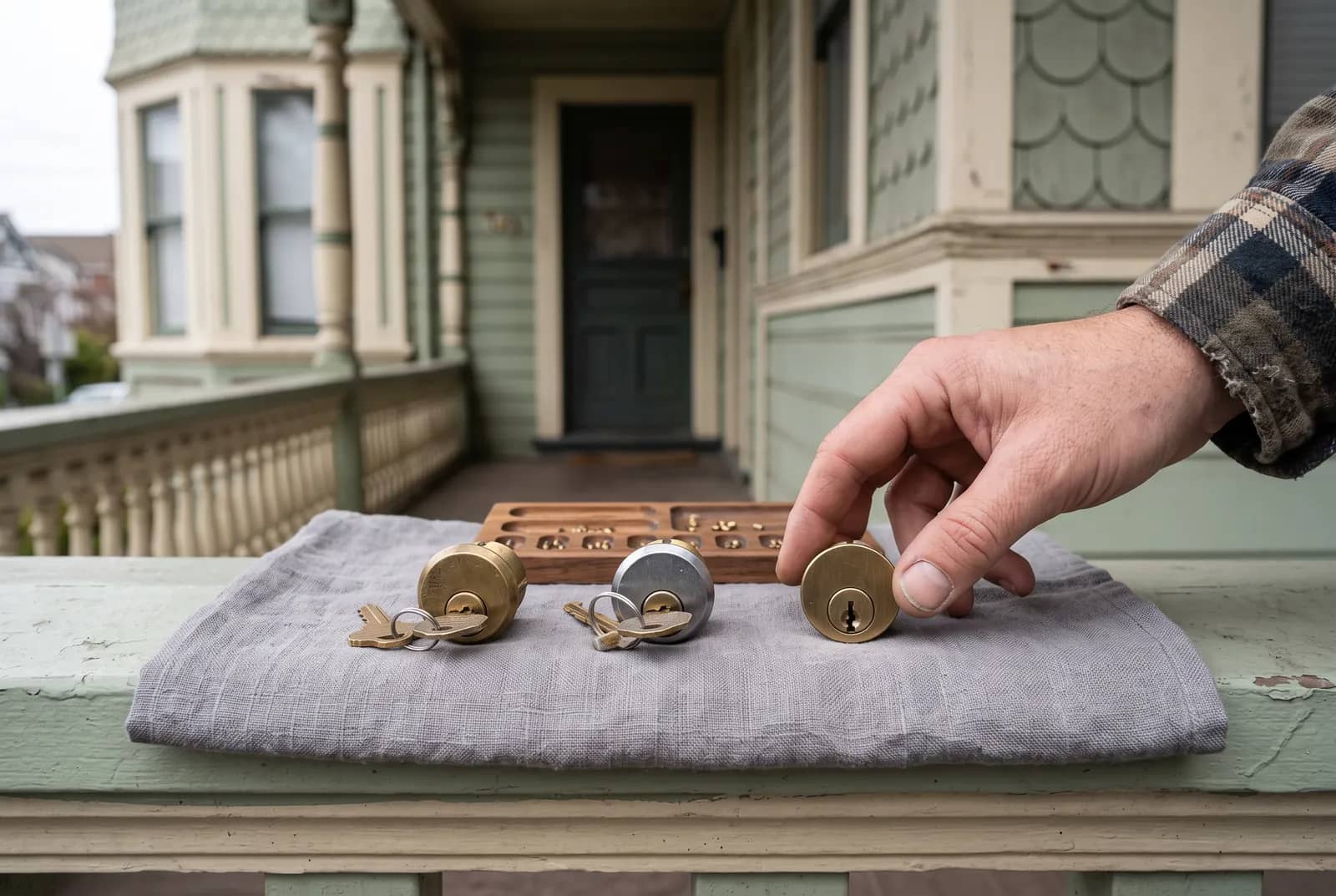
The door into the home is the clean case. The plug comes out, the old bottom pins drop away, a fresh set goes in to a combination nobody has used before, and a key is cut to match it. From the hallway nothing has happened. The same lock is on the same door with the same scratches on it, and the only thing that has changed is that yesterday's brass is now scrap.
That is $30 to $47 per cylinder. A home with a deadbolt above the knob is two cylinders on one doorway, which is worth saying before the figure is quoted, because people count doorways and the price counts keyholes. Where a home has only ever had a latch and a button in the middle of the knob, adding a proper bolt is $127 to $332 and does more for that door than anything else on the list.
One limit is worth hearing before the visit rather than during it. A plug that has been turned several times a day for decades is worn, and a fresh combination in a worn plug is a lock that still needs coaxing, only with different brass. If the key has wanted a particular angle for years, or a key from a neighbor's door will turn it, that cylinder is finished and you hear it with the thing in hand.
The cylinder that belongs to everybody
The street door is where this gets interesting. It is one cylinder, and every household in the building has a key in it. Repin it and all of those keys stop at the same moment, not just the one belonging to the person who left. If that is done at four in the afternoon and two keys are cut, the building has people standing on the porch by seven.
So when the street door is part of a move-out, it is planned as its own piece of work rather than tacked on at the end of the visit. Count the homes, cut a key for each with a spare or two, and agree who is handing them out and when. That is not a difficult job. It is a job that has to be finished on the same day it is started, which is a different thing.
It is also a job ordered by whoever holds the building rather than by the household that is leaving or the one arriving. The reason is the same arithmetic: three other homes are carrying that key and none of them are on the call.
What is decided before the van is loaded
There is one formulation on this and it does not change. Whether a lock gets touched on a rented home is settled between the resident and the owner before anybody moves out. What a locksmith does is ask on the call: which door, who has agreed to the work, and whose name is on the receipt. Those three answers are the difference between a job that happens and a technician standing in a hallway with nothing to do.
The receipt can be addressed to the resident, to the owner or to both, and a plain written line describing what was done on which door is available for whoever needs to file it. That line is usually what settles a reimbursement conversation later, and it costs nothing to ask for at the time.
The other useful sentence is about the mail door, which nobody thinks of as a lock and which carries more than most doors do. It has its own answer, and it is set out in the piece on the row of mail doors in the entry.
The turnover that resets the count
The reason to do this in the gap between one household and the next is not tidiness. It is that on the day the home is empty and the next arrival has not yet been handed anything, the number of keys in existence is knowable for the first and only time. Everything before that afternoon can be retired in one visit, and everything after it can be written down.
So write it down. Two lines on paper in the building's file: how many keys were cut for that door, and which one went where. It takes half a minute and it turns the next turnover from a guess into an arithmetic problem with an answer.
There is a practical reason as well. A home between households has nothing standing against its doors and a stair with no boxes on it, so a technician works from the top of the building down to the porch without waiting on anybody. The same list a week later, with furniture arriving, takes twice the time for the same figure.
The money and the hours
Rekeying is $30 to $47 per cylinder. The first one is the expensive one, since the combination has to be picked and a key cut and tried against it, and each cylinder after that copies work already done, so it drops toward the low end. The $89 visit is charged once for the stop however many keyholes end up on the list, which is exactly why a move-out is booked as one appointment instead of three.
A lock replaced and fitted is $127 to $332. If nobody can get into the home at all on the day, that is a house lockout at $132 to $242. Fifty dollars rides on an arrival between 8pm and midnight and eighty-eight on one after midnight, both counted into the figure before you agree to it. The work carries ninety days.
Timing is the free part. A weekday afternoon in the gap between households costs less than nine at night when somebody has thought of it on the way to bed, and there is nothing about new pins that wants to happen in the dark.
Quick answers
Does the street door have to be rekeyed when one household leaves?+
That is the building's decision, not one home's, because every household in the house is carrying that key. Where it is done, it is planned so that keys reach every home the same day rather than being finished the following week. The homes' own doors are separate jobs and can go ahead on their own.
Who pays for the rekey when a tenancy ends?+
That is settled between the resident and the owner before anybody moves out, and we ask on the call who has agreed to the work and whose name the receipt carries. The receipt can be addressed to either party or to both, with a written line describing the door and the work.
How many cylinders does one home in a divided house usually have?+
Two or three. The home's own door often has a knob and a deadbolt, which is two keyholes on one doorway, and there may be a back stair door or a storage bay as well. At $30 to $47 each with the $89 visit counted once for the stop, the whole list is a short appointment.
Need it handled rather than read about?
(510) 439-0869