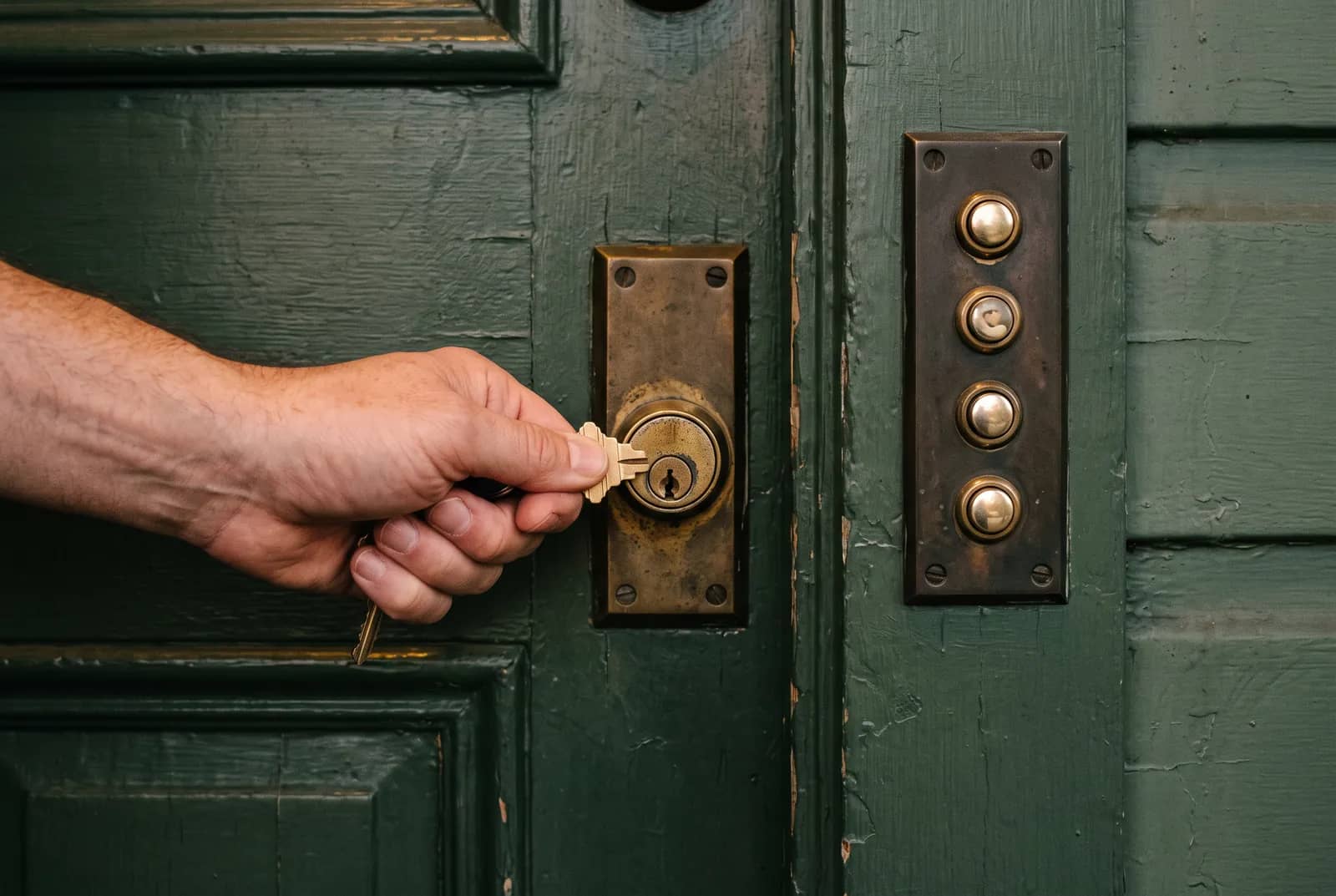
One house from the sidewalk, several homes behind the glass
A good share of the wooden houses on this island are not what they look like from the street. The Victorian and Edwardian frontages down the middle of Alameda were built as single households and a great many of them were divided somewhere along the way, upstairs from downstairs, front from back. Nothing about the outside changed. There is still one porch, one set of steps and one door with glass in the upper panel.
What did change is behind it. The door opens into a hallway with a stair, and off that hallway and at the top of it are doors into homes that have nothing to do with each other. Four households, four kitchens, four rent days or four sets of paperwork, and one cylinder standing between the whole arrangement and the sidewalk.
That single cylinder is the reason the calls from these streets sound different from the calls anywhere else in the East Bay. On a house with one family in it, the front door lock is a household decision. Here it is a building decision, and the person standing in front of it is not always the person who gets to make it.
Three doors, and everyone calls all three the front door
The first is the street door on the porch. It has one lock, sometimes two, and every adult in the building carries a key to it. It is opened and shut more times in a day than any other door on the property, and it usually has a spring or a closer on it because nobody wants it standing open onto the sidewalk.
The second is your own door, which is at the top of the stair, or off the hallway, or around the side under the back steps. That one has your name behind it and nobody else's key in it. It is a household lock in every ordinary sense.
The third is the set of doors that serve the building without belonging to any one home: the back stair off the kitchens, a basement door under the porch, the cupboard that holds the meters, the gate into the yard that two houses share along a fence. Those are used by everybody and instructed by nobody in particular, which is exactly how they end up neglected for years.
Almost every wasted trip in this city comes from the second and the third being described in the same sentence. Somebody says the front door will not lock, a van is loaded for a flat door, and the door that actually needs work is the one on the porch that four households share.
Working out which one is yours to instruct
Your own home's door is straightforward. If you own the flat, you instruct the work. If you rent it, whether a cylinder gets touched is settled between the resident and the owner before anybody moves, and all a locksmith does is ask on the call who has agreed to it and whose name goes on the receipt. That question takes ten seconds and it saves a wasted afternoon at both ends.
The street door, the stair, the back stair and the meter cupboard are a different category, and the reason is arithmetic rather than paperwork. Putting new pins in the street door cylinder stops every key in the building on the same afternoon, including the ones belonging to people who are at work and have heard nothing about it. Three homes would discover that on the porch at six in the evening, which is not something one neighbor gets to do to another, and not an instruction this trade should be taking.
So work on a shared door is ordered by whoever holds the building: the owner, the family that owns it and lives on the ground floor, or a management company with a named person answering the email. Four things settle it. Which door, what is being done to it, how many keys are to be cut, and who is paying. Written down in that order it takes a minute and it is enough to schedule the job.
Why the street door produces most of the calls
It is the busiest lock on the property by a wide margin. Four households coming and going, deliveries, laundry, bins out on the right morning, somebody stepping onto the porch to take a phone call. A cylinder that four sets of hands use a dozen times a day wears at four times the rate of the one upstairs, and the keys wear with it. A brass key that has been copied from a copy, in a plug that has done twenty years of that traffic, is a key that starts needing a particular angle before it needs anything else.
The second reason is the spring on the door. The commonest lockout on these streets is not a lost key at all. Somebody comes down in the evening to fetch something from the car or to move a bin, the street door swings shut behind them on its closer, and their own keys are on the kitchen table two floors up. They are on the sidewalk, the hallway is lit, and there is nothing to be done about it from where they are standing.
That is a house lockout at $132 to $242. The $89 for coming out is counted into that number before you hear it rather than added under it, and an arrival between 8pm and midnight carries $50 while one between midnight and 7am carries $88, both named while you are still on the phone. Getting a resident back into the building is a different question from changing anything, and it is answered with photo ID showing the address, or ID plus something on the phone that ties you to the place.
Who the invoice goes to when four households share a cylinder
Settle it before the work starts and it stays settled. The instruction for a shared door should carry a name and a door on it, and it should exist somewhere other than in a phone call. That is what decides which address the invoice is made out to when the technician sits down to write it.
It does happen that a resident wants a shared door dealt with out of their own pocket, usually because it has been sticking for a year and nobody has acted. That is a fair thing to want and it still goes past the owner first. Otherwise the ending is easy to predict: money spent on the porch cylinder, a request for it back, and a building that declines to cover something it never asked for. Nobody was in the wrong there. The instruction simply started at the wrong end of the hallway.
Keys are the other half of the paperwork. If the street door is repinned, four households have to be holding a working key by the end of the same day, and somebody has to write down which copy went to which home. A shared door rekeyed at four in the afternoon with two keys cut is a building with people locked out of it by seven.
The figures, and the sentence that shortens the call
Rekeying is $30 to $47 per cylinder, and the second and third on the same visit sit at the low end of that because the pattern has already been set and the van is already at the curb. A lock replaced and fitted is $127 to $332. A house lockout is $132 to $242. A door that has been forced is put back as one job, jamb, strike and cylinder together, at $169 to $445, with each part on its own line because a claim needs lines rather than a total. Ninety days runs on the work itself and it is written on the receipt in words.
Arrival across the island averages 18 minutes. Park Street runs about 12, Gold Coast 14, Fernside 16, Central Alameda 18, South Shore 20, the West End 22, Alameda Point 25 and Bay Farm Island 27 across its own bridge. Those are uneven because the crossings are uneven, and the figure you are quoted is the one for your neighborhood rather than the average.
One sentence at the start of the call does most of the work: say whether the door is the one on the sidewalk or the one behind it. Everything else follows from that, including what is loaded into the van, what identification is needed at the door and who is asked to authorize the job.
Quick answers
The street door of my building will not lock. Can I book the repair myself?+
Ask the owner or the manager first, because that cylinder is carried by every household in the building and changing it changes what all of them are holding. With a short written instruction naming the door it can usually go on the same day's schedule, and the invoice goes to the building rather than to you.
I am locked in the hallway and my keys are upstairs. What is that?+
A house lockout at $132 to $242, with $50 on an arrival between 8pm and midnight and $88 after midnight. Your own door is opened where the mechanism allows it, and the shared street door usually does not have to be touched at all. Bring photo ID with the address, or ID plus a lease page or addressed mail on your phone.
I rent one of the flats. Can I have my own lock rekeyed?+
That is settled between the resident and the owner before anybody moves, and we ask on the call who has agreed to it and whose name the receipt carries. What is not in question is being let back into the home you pay for, which is a lockout and is yours to arrange.
Need it handled rather than read about?
(510) 439-0869