Establish what you bought before you count anything
Three things get sold on these streets that look identical from the sidewalk. A single house with one household in it. A house divided at some point in its life, with a home upstairs or at the back that somebody else is living in and paying for. And one home inside a house that was divided decades ago, where you own your part and share the porch with three others.
The paperwork told you which of the three you have. The frontage did not, because a Victorian that was cut into homes seventy years ago still has one porch, one door and one bell push that somebody replaced with four. This matters more here than the number of locks does, because it decides which doors you can instruct and which you cannot.
So write that down first, in one sentence, before walking anywhere with a notepad. It is the sentence the call starts with too.
Sort the doors by who opens them
Then walk the property and put every opening into one of three groups. The first is doors only your household opens: your own entry, the door from the kitchen to the back steps, a basement door under the porch, a garage off the alley, a shed at the end of the yard. The second is doors shared with other households: the street door on the porch, the stair, a back stair, the meter cupboard, a gate in a fence that two houses use. The third is the things that are not really doors: keypad codes, a garage opener, a mail compartment, a safe left in a closet.
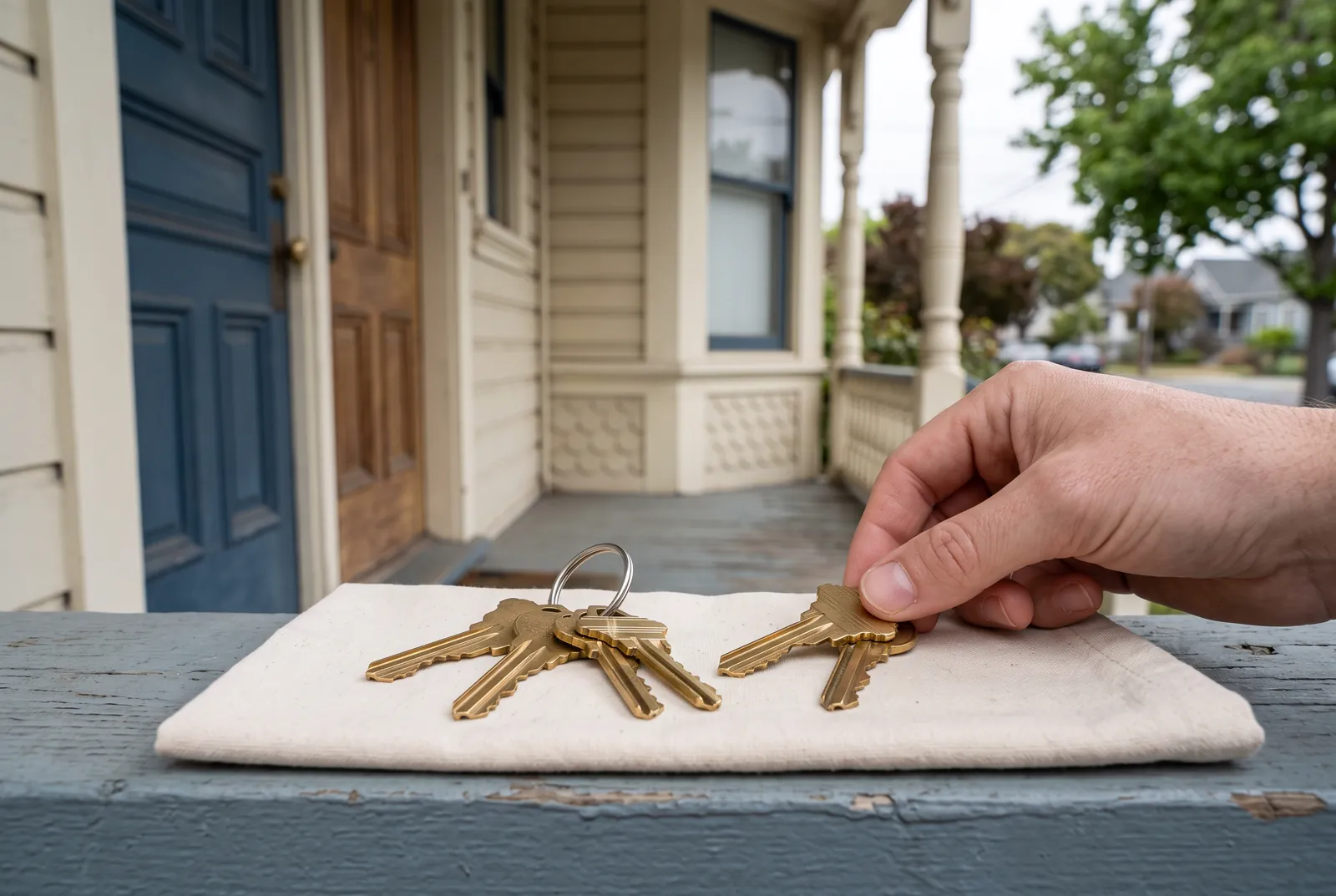
Count keyholes as you go, since keyholes are what a price list counts, and read the name stamped in the brass ring around each one. Those names matter more than the count does. A key physically enters only the cylinders whose keyway it matches, so what is written around the holes decides whether the property can end up on one key, whether it needs three, or whether one cylinder has to be swapped for a different family before the rest will agree with it.
On a house of this age the list will be untidy, and that is normal rather than a sign of neglect. Hardware here arrives in layers: something original on the front, something bought at a counter for the back steps, a padlock somebody put on the yard gate in a hurry, and a cylinder in the basement door older than any of it.
Group one: the afternoon that closes the list
Everything in the first group can be settled in a single visit. Rekeying is $30 to $47 per cylinder, and once the first one has fixed the combination and produced a key, the rest are repetition and land low in the band. One $89 visit covers the stop no matter how long the list runs. When it is finished, whatever brass was cut and passed around while the place was on the market opens nothing.
This is not a judgment about anybody. A house on the market is opened by more people in six weeks than it sees in the next two years, the lock box came off on the last day, and there was never a moment when somebody was responsible for the count. That is all. The first month is simply when the count gets closed.
One thing worth saying before anybody starts selling you tidiness: a single key for the whole property is a poor target on a house like this. Several of these cylinders will never take the same blank, and hearing that plainly is worth more than four new locks bought so the result looks neat on paper. Two or three keys you can each describe in a sentence is a better outcome than one key paid for with money the basement door needed.
Group two: the doors that need somebody else's yes
If you bought a house with a home in it that somebody lives in, the street door and the stair are shared with that household. If you bought one home inside a divided house, the same doors are shared with three. Either way, changing a cylinder on them stops every key in the building on the same afternoon, and that is not a decision one household makes for the others.
Where a resident is involved, the sentence is the same one used everywhere on this site: whether a lock gets touched is settled between the resident and the owner before anybody moves, and we ask on the call who has agreed to it and whose name goes on the receipt. Where the building has a manager, the instruction comes from them, by email, naming the door.
None of that stops the first group happening. Your own doors go ahead on the day you close, and the shared ones follow when the conversation is finished. Splitting the list that way is what keeps a first month from stalling on one email.
Group three: the openings with no keyhole in them
Start with the codes, because they are free and because until you change one it is still somebody else's number. A keypad on a door, a pad on the garage jamb, an alarm panel if the manual turned up with the paperwork. Set aside an hour, work through the manuals, and that part of the list is finished without anybody driving out.
The garage off the alley gets skipped more than anything else on the property, and it is the opening a stranger could use with nobody on the street to see it. Look at the motor head for a small button marked learn or program. Holding it long enough empties the receiver, and the receiver is the only place the old handsets ever existed, including the one that left clipped to a visor. Teach your own back afterward. No amount of work on any cylinder does this, which is exactly why it gets missed.
Now and then a house comes with a safe standing in a closet and no combination, because the combination left with the sellers. That is safe opening at $198 to $529. It is worked open where it stands wherever the mechanism gives any way in, and then set to a number you pick and write down somewhere well away from the room it lives in. Send a photograph of the front of it with the call and the figure comes back much tighter.
The week to do it in, and what it comes to
Book it for closing week, not moving week. The keys that are worth thinking about were all in circulation during the months when the rooms were bare and anybody could be walked through them, so waiting for the furniture adds nothing but delay. It is also the shortest version of the visit: clear doorways, an empty stair, and one stop that covers the whole list.
The figures for a normal first month here: rekeying at $30 to $47 a cylinder, a deadbolt at $127 to $332 anywhere an exterior door is running on a latch alone, and a keypad at $192 to $479 if you want one, on the door the household actually uses rather than the one facing the street. Fifty dollars rides on an 8pm to midnight arrival and eighty-eight on one after midnight, both counted in before you agree. Ninety days on the work, in words on the receipt.
Arrival averages 18 minutes, from about 12 in the Park Street District to 27 on Bay Farm Island across its own bridge, and the number for your street is the one you are told rather than the average.
Quick answers
We just closed. New locks, or is a rekey enough?+
The question a sale leaves behind is who is still holding something that works, and fresh pins settle exactly that, at $30 to $47 a cylinder. Spending $127 to $332 a door on hardware that was doing its job buys metal instead of an answer. Replacement belongs to a lock that is worn out or a door that has never carried a bolt at all.
I bought a house with a resident already living in part of it. What can I do on day one?+
Everything on the doors only your own household uses. The street door, the stair and anything else shared with that home is settled between the resident and the owner before anybody moves, and we ask on the call who has agreed to it. Splitting the list that way means the first group is not held up by the second.
How many cylinders does a divided house here usually have?+
More than people expect. A street door, a door into each home, a back stair, a basement door, a garage off the alley, a yard gate and a mail compartment is already seven or eight keyholes. Read the keyways down the phone rather than the doorways and one figure comes back with the $89 stop counted once.
Need it handled rather than read about?
(510) 439-0869