What the little lock actually is
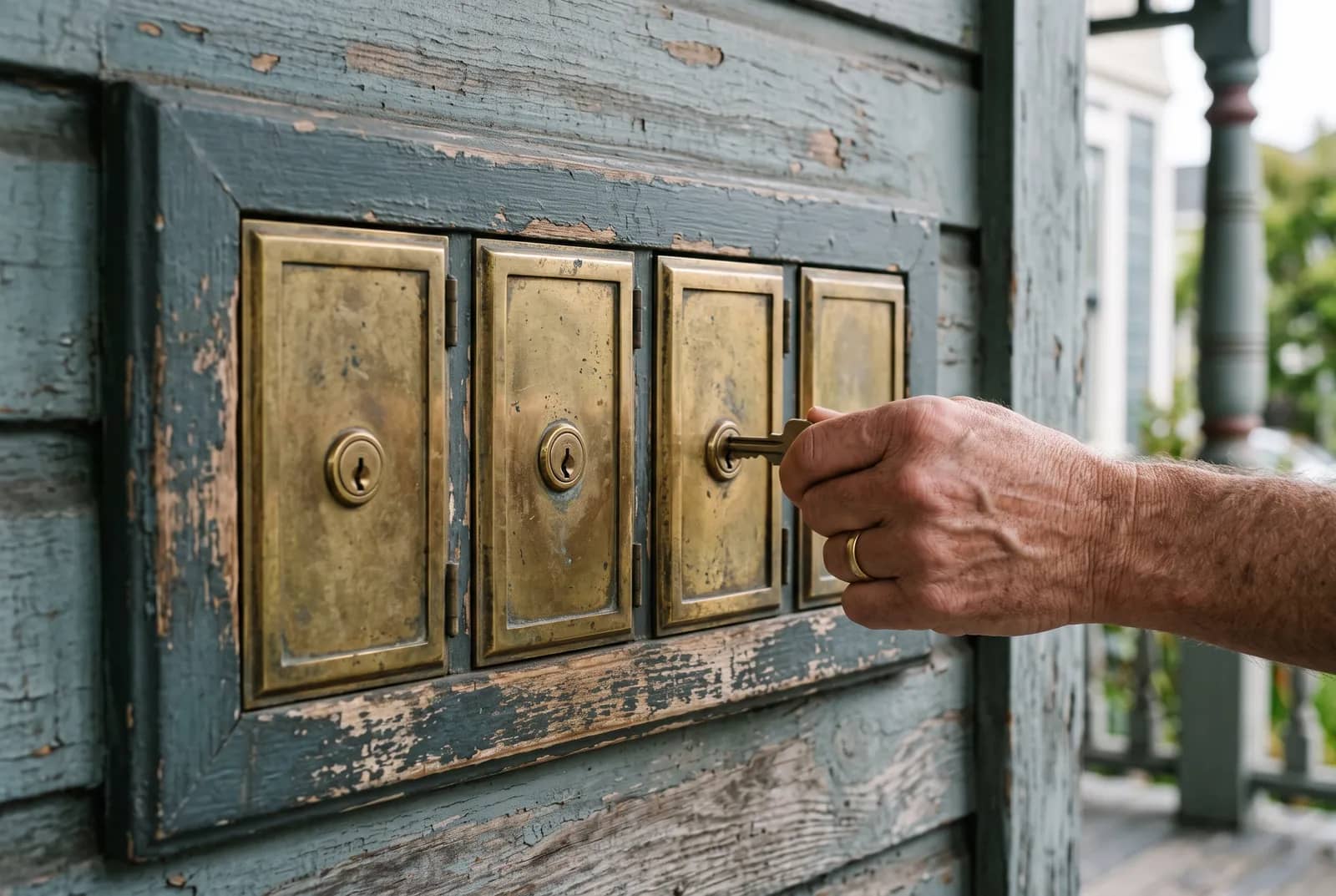
Inside the porch of a divided house here, usually on the wall beside the inner door, there is a panel with three or four small doors in it and a number stamped or written on each. What holds one of those doors shut is about as simple as a lock gets: a stubby cylinder with a flat steel tab fixed to the back, and turning the key swings the tab across so it catches on the inside of the frame. No bolt, no latch, no spring worth mentioning. It is lighter than anything else in the building and it lives indoors, which is the only reason it lasts as long as it does.
On newer blocks the same job is done by a different object. Around South Shore, on Bay Farm and among the new housing at Alameda Point, mail more often arrives at a freestanding cluster unit on the sidewalk, with a bank of compartments in a steel pedestal. It looks like the same thing and it is not, which is the first fork in this conversation.
What the compartment holds is why any of this matters. Replacement cards, tax paperwork, a statement, a renewed license. A mail door is the lowest-value hardware on the property and one of the higher-value openings on it, and that mismatch is the whole reason people are surprised by how seriously it gets treated.
The first question is which row you have
A panel inside the entry of an older house belongs to the building. The compartment doors and their little cylinders are the building's hardware, they can be changed, and the decision sits with whoever holds the house rather than with the postal service.
A cluster unit standing on the sidewalk is a different matter, and on those the first call should go to the local post office rather than to a locksmith. The arrangement varies with how the unit was installed and who has been maintaining it, and the honest answer at the curb is that the station can tell you in a minute what nobody can tell you from a photograph.
In either arrangement there is one lock nobody in this trade goes near, and it is worth naming plainly so no one wastes a call on it. The carrier gets at the whole panel in one movement, through a door of their own with their own lock in it. That lock is the postal service's property from end to end. It does not get repaired, changed or opened by a private locksmith at any price, and a company that offers to open it is telling you something useful about itself.
What happens when a compartment key is lost
On a building panel the work is small. A nut behind the compartment door releases the old cylinder, a new one goes in and two keys come with it. What takes any care at all is the tab: it has to be the right length for the depth of that frame and it has to finish square when the key is turned, or the door will feel locked and open under a thumb. Ten minutes on a good day, and longer on a panel somebody has painted around three times.
It is priced as lock replacement and installation, $127 to $332, and a single compartment on a panel that is in reasonable order sits at the bottom of that band. The $89 for the visit is inside the figure rather than arriving separately underneath it, and where several compartments are being done at once the whole row is one stop rather than four.
There is no repinning route on most of these. The cylinder costs little enough that it is exchanged rather than dismantled, and nothing is gained by keeping the old one in service. Where the panel is far enough gone that the compartment doors have worn at their edges and no longer sit square in the frame, you hear that before anything is ordered, since a fresh cylinder in a door that has stopped closing properly fixes nothing at all.
What is asked at the door, and why
Two things. Which compartment, by the number on it, and something that ties you to that address: photo ID with the address on it, or ID plus a piece of addressed mail, a lease page, a utility bill on the phone. On a shared entry that check is not a formality invented to slow the job down. It is the only reason anybody should be willing to open a mail compartment for a stranger in a hallway with four homes off it.
The second question is who is instructing the work. A single compartment on a building panel is usually straightforward and the household that uses it can ask for it, with the owner or the manager told what was done. Where the whole row is being changed, or where the panel itself is being replaced, that is building work and it is ordered by whoever holds the building. Naming the compartment number in the message is what keeps that short.
On a rented home the same sentence applies as everywhere else on this site. Whether hardware is changed is settled between the resident and the owner before anybody moves, and the call is where we ask who has agreed to it and whose name goes on the receipt.
The row nobody has touched in twenty years
Panels in these entries tend to be the last hardware in the building anybody looks at. Two things happen over that kind of stretch. The tabs wear round at the edge and stop catching properly, so a compartment stands ajar after the carrier has been and the mail is visible to four households and everyone visiting them. And the key count drifts upward, because every turnover issues one more and nobody was ever collecting the last.
Doing the row together rather than one door at a time is materially cheaper. One stop, one visit fee, and the cylinders after the first go quickly because the panel is already open and the pattern is already set. On a four-compartment panel it is the difference between an appointment and four of them.
The other thing worth doing at the same time is labeling. A panel where the numbers have worn off the doors and nobody knows which compartment is which produces at least one call a year on its own. A number that can actually be read is free.
Figures and hours
A compartment lock changed is priced inside lock replacement and installation, $127 to $332, and one small cam on a sound panel is at the bottom of it. Rekeying elsewhere in the building on the same stop is $30 to $47 per cylinder, which is why a mail door is very often done alongside a home door rather than by itself. The $89 for the stop is counted once whatever is on the list.
An arrival between 8pm and midnight carries $50 and one between midnight and 7am carries $88, but there is seldom a reason to pay the hour for a compartment door. The mail has already been delivered. Ninety days covers the work, written on the receipt.
Across the island the average arrival is 18 minutes, with Park Street about 12, Fernside 16, Central Alameda 18 and Bay Farm Island 27 over its own bridge. If your mail arrives at a cluster unit on the sidewalk rather than a panel in the entry, say so on the call and you will be pointed at the post office instead, which is a shorter conversation and a free one.
Quick answers
Can a locksmith change the lock on my mail compartment?+
On a panel in the entry of a building, yes. That is the building's hardware, so the little cylinder comes out and a new one goes in with two keys, priced inside the $127 to $332 line and sitting at the bottom of it for a single door. The door the carrier uses to reach the whole panel is postal service property and stays shut to this trade.
My mail comes to a cluster unit on the sidewalk. Is that the same job?+
Not necessarily, and the first call there should go to the local post office rather than to us. Who maintains a freestanding cluster unit depends on how it was installed, and the station can answer that in a minute. It saves you a visit fee for an answer over the phone.
What do I need to have with me?+
The compartment number and something that ties you to the address: photo ID with the address, or ID plus addressed mail, a lease page or a bill on your phone. On a shared entry that check is the only reason a compartment should be opened for anybody, and it takes under a minute.
Need it handled rather than read about?
(510) 439-0869More guides