Five ways on, and that is the whole list
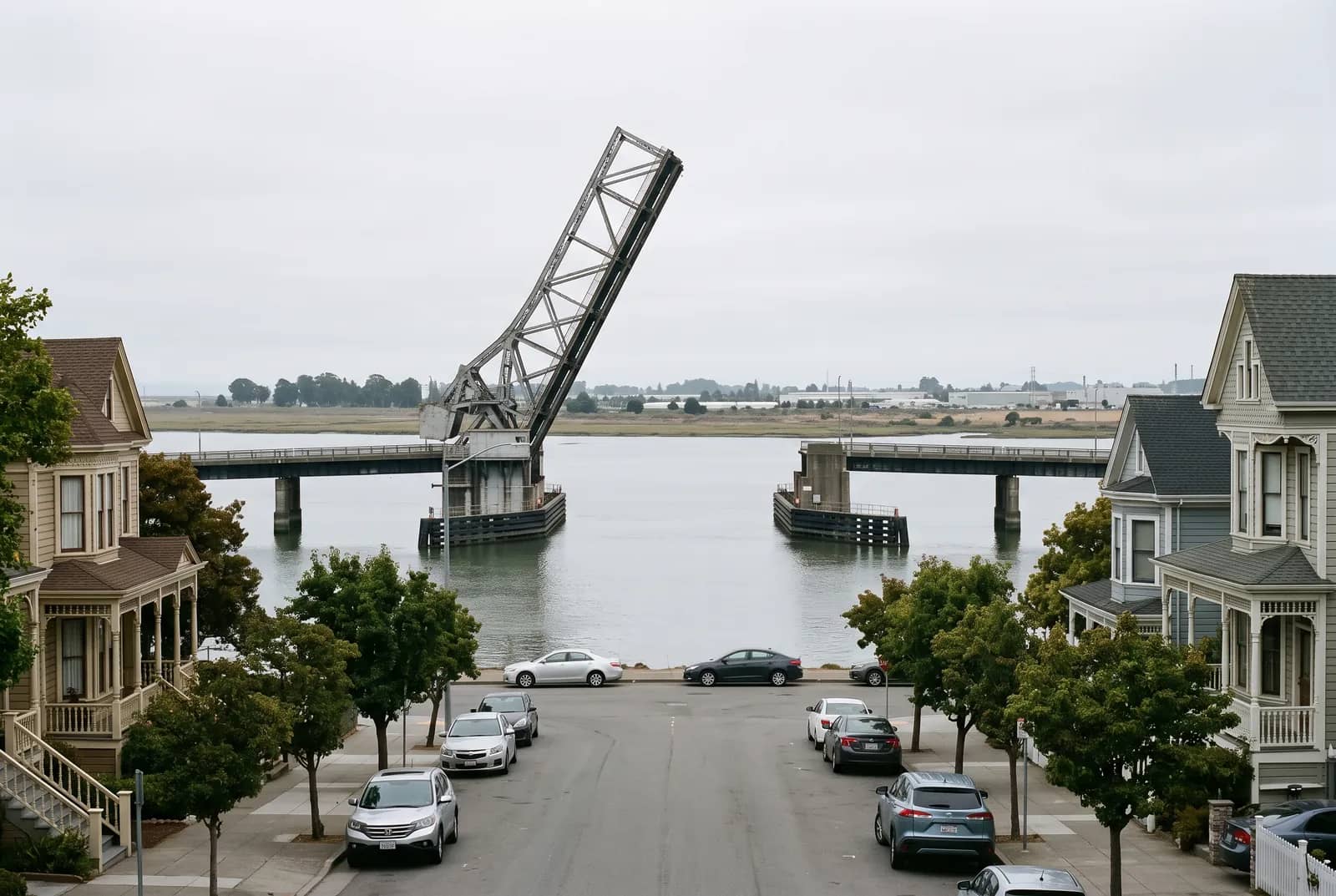
Alameda is an island, and the ways onto it can be counted on one hand: two tubes running under the estuary and three bridges that lift. There is no sixth. Every van, every delivery, every person coming home from work crosses at one of those five points, and which one they use is decided by where they started rather than by preference.
That is an unusual situation for a service that measures itself in minutes. In most cities the drive is a line between two points and traffic is the variable. Here the drive is a choice between five gates, and the gate is fixed by geography before the engine starts. A van sitting near Park Street and a van sitting in the West End are not the same van for the purposes of an address on the eastern shore.
It also means that the honest way to quote an arrival is not to average the city and say a number. It is to know which crossing the van is on the far side of, and to say what that costs in minutes.
A lift is the city working, not the city failing
The three bridges lift for vessels on the water. That is what they were built to do, it happens on the shipping's schedule rather than on anybody's convenience, and it is a normal part of how this place operates. A bridge standing open is not a fault, not a closure and not an emergency, and describing it as one would be silly.
What it is, for anyone timing a drive, is a stretch of a few minutes during which one of the five ways onto the island is simply not available. Traffic behind it holds, then clears. The van either waits or, if the technician saw it coming and had the option, took a different crossing.
The practical consequence is small and it is worth saying out loud rather than absorbing quietly into an estimate. If a lift is in the way, the number you were given moves and you are told that it moved. Padding every quote by five minutes to cover the possibility would be the easier approach and it would make the honest days worse for everyone.
Why two neighborhoods that look close are not
Look at the island on a map and Fernside on the eastern shore and the West End at the far tip are both simply parts of one strip of land a few miles long. The published arrivals are 16 minutes and 22, and the gap is not laziness about the West End. It is the crossings.
Fernside sits beside the bridge at Fruitvale, so a van arriving from the Oakland side comes almost straight to it. The West End is reached through the tubes and then a run down the length of the island, or across from the far side, and neither of those is short. The distance in a straight line says one thing and the road says another, and only one of the two is a number anybody can drive.
The same applies to Bay Farm Island, which is not part of the main island at all. It is its own piece of land across its own bridge, which is why 27 minutes is written next to it rather than folded into an average that would flatter the map and disappoint the caller.
The published numbers, neighborhood by neighborhood
The average across the island is 18 minutes. Park Street District runs about 12, which is the shortest number on the list because the base sits near it. Gold Coast is about 14, Fernside 16, Central Alameda 18, South Shore 20, the West End 22, Alameda Point 25 out among the hangars, warehouses and the new housing at that end, and Bay Farm Island 27 across its own bridge.
Off the island the numbers are Oakland 16, Emeryville 21, Piedmont 23, Berkeley 25, San Leandro 26 and San Lorenzo 29. Those are quoted at the same figures as any Alameda address, because the drive is the technician's problem and the price list is not a map.
Every one of those numbers already has the crossing inside it. They are not distances converted into minutes. They are what the drive has actually taken, which is why they are uneven in a way a straight-line map would not predict.
What the hour changes and what it does not
Only one thing on this page moves a figure, and it is the clock. An arrival between 8pm and midnight carries $50 and one between midnight and 7am carries $88, both counted into the number while you are still on the phone. Nothing is added for a crossing, for the length of the drive, or because the run took the technician longer than expected. A drive that goes badly is the van's problem and it has never been a reason to reopen the arithmetic at the curb.
A house lockout is $132 to $242 in the Park Street District and it is $132 to $242 on Bay Farm, with the $89 call-out already inside it. A car lockout is $108 to $202 whether the car is at Crown Beach, in a lot behind the shops or at the marina. What the address changes is how long you wait, and that is said before you agree to wait rather than after.
Where a wait is going to be at the long end, the number you hear is the long one. Being told 27 minutes and seeing a van at 24 is a better evening than being told 15 and standing on a porch at half past.
Two sentences that make the estimate worth something
The first is your neighborhood, or failing that a cross street. Not the city, because the city is eight neighborhoods and the published figures across them run from 12 minutes to 27. Saying Fernside, or Bay Farm, or the West End turns a shrug into a number.
The second is whether anything stands between the curb and the lock. A porch shared with three other homes, a gate on the side path, a stair inside the entry, a garage reached from the alley behind the house, a parking structure with a level and a bay. Those add minutes at the arrival end rather than the driving end, and they are the ones most often left out.
Everything else, including which crossing the van will use and whether a lift is likely to be in the way, is the technician's arithmetic rather than yours. It is done before the estimate is spoken, and if a bridge changes it afterward, you get told.
Quick answers
Does it cost more to reach Bay Farm or the West End?+
No. Every figure on the list is the same at any address on the island and in the neighboring cities. What the address changes is the wait, published as 12 minutes in the Park Street District through to 27 on Bay Farm. The only additions anywhere are the hour, $50 after 8pm and $88 after midnight.
What happens to my arrival time if a bridge goes up?+
The bridge lifts for a vessel, which is normal operation and takes a few minutes. If it falls in the way of the van you are told that the number has moved rather than left to watch the street. Where the technician has a usable alternative among the other four crossings, that is taken instead.
Why is the West End slower than Fernside when they are on the same island?+
Because of which crossing serves each. Fernside sits beside the Fruitvale bridge and is reached almost directly. The West End is reached through the tubes and then along the island, or from the far side. The published 16 and 22 minutes are what those drives actually take rather than what the map suggests.
Need it handled rather than read about?
(510) 439-0869