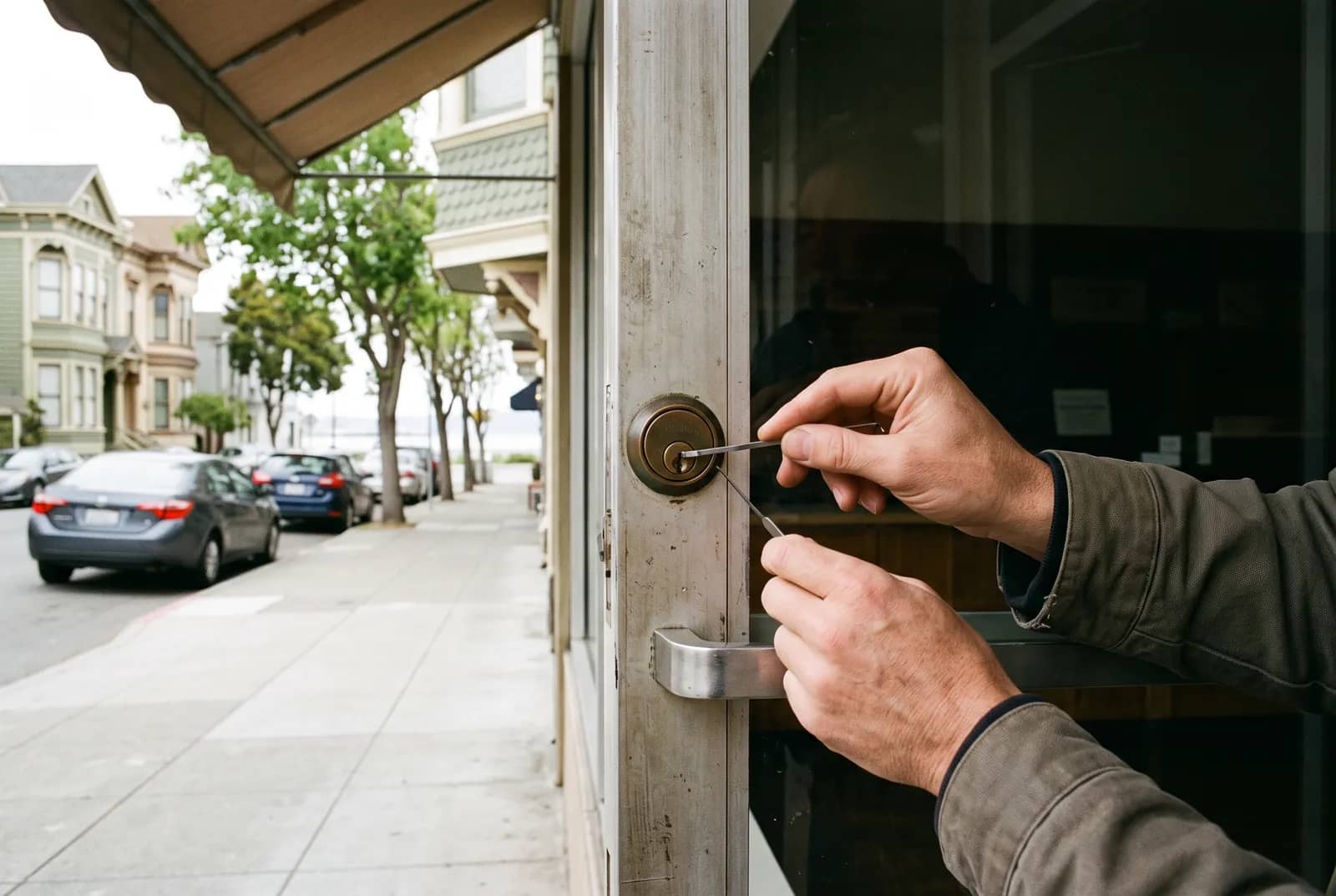
A door that opens onto the sidewalk
Park Street is a walking street. The buildings meet the pavement, the shopfronts are glass, and the doors open more or less straight onto people going past. There is no forecourt, no parking bay in front and usually no lobby: the distance between the sidewalk and the counter is the width of a mat.
What is on those doors is one of two things. Most are a narrow aluminum stile with glass in it, a deadlatch at the handle and often a hook bolt above or below, with a closer overhead. A smaller number, in the older brick frontages, are wood and glass in a masonry opening with hardware that has been added to in layers over a long time. A handful are a recessed entry with an outer and an inner door, which is two doors to think about rather than one.
The doors on the cross streets and along Webster Street behave the same way and take the same hardware, so everything below applies to all of them. Arrival to the Park Street District is about 12 minutes, which is the shortest figure on the map.
Five jobs, one leaf
It is worth listing what a shop door is expected to do, because the list explains every fault later on the page. It has to latch behind a customer who lets go of it. It has to be openable by somebody carrying a box, which usually means a lever or a paddle rather than a knob. It has to close itself, at a speed that does not slam and does not leave the door resting a quarter inch short. It has to lock at night in one movement by a person holding keys and a phone. And at every moment while there are people inside, it has to let them out without a key and without doing two separate things in sequence.
That last one outranks all the others and it is the one that decides what may be fitted. A shop can be as secure as it likes at three in the morning. During trading hours, the way out is the requirement, and the hardware chosen has to handle both states by itself rather than depending on somebody remembering to change something at nine.
A caveat before any of the detail. Nobody in this trade, and no page on any website, decides what is acceptable on your premises. The officials who look at your building do. What is set out below is the hardware that ordinarily goes on a door like yours and ordinarily passes without a conversation. If you have already been given a specific instruction about your own door, that instruction is the one we fit to.
The three faults that come in first
The last inch of the close. Overhead closers have separate valves for the swing and for the final few degrees, and on most doors both were set on the day of installation and have not been looked at since. As the unit tires, the door stops finishing the movement. It comes to rest a fraction short, propped on the weatherstrip, and from six feet away it is a closed door. The latch is sitting on the face of the strike rather than in it, so anyone can pull the door open with one hand while the shop believes it is locked. A door on this street that is opened and shut several hundred times on a busy Saturday drifts out of adjustment in months, not years.
The plunger beside the latch. A deadlatch has a small secondary pin next to the main latch, and its whole job is to sit against the face of the strike so the latch cannot be pushed back with a card. When the door has dropped a few millimeters, or the strike has moved, that pin lands in the hole alongside the latch instead of on the metal beside it, and the deadlatching stops working entirely. Nothing about the key or the handle tells you that has happened.
The bottom of the leaf. Shop doors on this street take stock trolleys, hand carts, sack barrows and the corner of a delivery every week of the year, all of it against the bottom rail. Over time the leaf racks slightly in its frame, the top corner leads and the hook bolt stops meeting its keeper. That is felt as a door that has to be lifted by the handle before the key will turn, and it is a door problem rather than a lock problem.
All three are storefront door work, $162 to $472 per door, and all three land low in that band when they are reported early. The same three, reported after somebody has pulled the door open one night, become a repair at $169 to $445 with each part itemized for a claim.
The other door in the same frontage
Look along Park Street at the ground floor and count the doors. Beside a great many shopfronts there is a second, narrower door with no window display beside it, and behind it a stair going up to offices or to homes on the floor above. That door is in the same building and the same brickwork and it is not the shop's.
It belongs to whoever holds the building, and so does the stair, the landing, the mail row at the bottom of it and often the rear door onto the lot behind the block. Every tenancy above the shop reaches the street through that door, which is exactly why one tenant cannot decide what happens to its cylinder. A rekey there changes what an accountant on the second floor is carrying tomorrow morning, and nobody asked the accountant.
This is the same arithmetic as the porch on a divided house three blocks away, and it is not an excuse to stall. What is needed is a message from somebody who holds the building, naming the door and saying what is to happen to it. That message is what schedules the work and what determines the address on the invoice. Your own shop door, your own rear door and your own stockroom you instruct on your own, and in practice both halves are done on one visit once the building's half has been agreed.
Look at the lease in the same half hour. Commercial leases along here generally want the landlord holding a working key and often want warning before a cylinder is changed, and none of that is difficult while the technician is standing there. Change it, cut an extra, send a line by email saying what was done. The tenancies that end badly over locks are always the ones where nothing was written down at the time.
The back door and getting out
Behind the Park Street blocks there are service lanes and shared parking, and most shops have a rear door onto one of them. It is the door staff use, the door deliveries come through, and the door somebody has usually tried to make stronger with a hasp and a padlock, a slide bolt at the top, or a bar in brackets. Any of those in place while people are inside is the arrangement most likely to be pointed at.
A push bar settles all of that in one object. Lean on it anywhere across its width, with an armful of boxes and no light on, and the door is open. Let it swing back and it has latched itself. Put a cylinder in the outside face and staff come back in with a key like any other door. Exit devices are $302 to $769 per door fitted, and the spread inside that has almost nothing to do with the device. It is the leaf. A rear door still hanging square is the bottom of the band, and one that has to be squared up before a bar can be bolted across it is the top.
Two things that follow from it. If the rear door gets wedged open every afternoon because staff cannot work the handle with their hands full, no hardware on earth will change that habit, and the fix is a keypad or a reader on the outside face rather than a wedge on the floor. And where the lane door is shared with the offices upstairs, it has stopped being your door and gone back to the building, with the same named person and the same message.
Keys, staff and the figures
A shop that has been open a few years has more keys in the world than its owner can list. Two things reset that. A restricted keyway, so blanks cannot be cut over a counter by whoever is holding one, and a chart small enough to fit on a card: the owner's key opens the lot, a closing shift's key opens the front and the lane door and stops at the office and the stockroom. Those are the two lines on the price list with no range printed against them, and the reason is that a chart is drawn from real doors. Somebody counts them on the premises first and the figure arrives in writing before anything is ordered.
The published lines for a shop here: storefront door locks $162 to $472 per door, panic bars and exit devices $302 to $769, business lockout $141 to $258, repair after a forced door $169 to $445, rekeying $30 to $47 per cylinder with the doors counted on the call so one number comes back for the premises. The $89 for the stop is counted in rather than added at the end. Evening from 8pm carries $50 and overnight from midnight carries $88. Ninety days on the workmanship.
Two pieces of timing. Put door work in the hour before opening rather than at two on a Saturday with the entrance out of service and customers stepping around a technician. And check who is holding the alarm code before any cylinder is changed. A key that opens a door onto a panel counting down, held by somebody who cannot stop it, makes for a memorable start to a trading day.
Quick answers
Our glass door has to be lifted before the key will turn. Is the lock finished?+
Usually the lock is fine and the frame is not. Years of carts and deliveries against the bottom rail rack the leaf slightly, the top corner leads, and the bolt arrives beside its keeper instead of in it. Squaring the door and moving the keeper to meet it is at the low end of the $162 to $472 storefront line, and the existing lock body normally goes straight back on.
Can we put a padlock on the back door during the day?+
Not with people inside the premises. Anything that has to be unlocked or unhooked before the door will open puts a second step between a person and the lane, which is what gets pointed at first. A push bar does the same security job overnight and still opens under a shoulder at any moment, at $302 to $769 fitted.
Who orders work on the narrow door next to our shop that goes upstairs?+
Whoever holds the building. Everybody working or living on the floors above reaches the sidewalk through that door, so its cylinder is in several sets of hands and one tenancy cannot decide for the rest. Send the request from the building's side naming the door, and it is normally done on the same visit as your own shop doors.
Need it handled rather than read about?
(510) 439-0869